Essay · 11 September 2026
The Thermodynamic Uncanny Valley
Yet, the more we uncover, the less certain we are, and it is not simply a matter of there being nearly infinite stuff to learn; it's also that in our race to understand, we're confusing scales of time and size.
In my research efforts to better understand the world to define my place in it (and isn't that ultimately what we all search for through various mediums?), one thing that has been cemented in my understanding is that the laws of thermodynamics are immutable. No one beats the laws of creation themselves. Not even the universe. Yet, the more we uncover, the less certain we are, and it is not simply a matter of there being nearly infinite stuff to learn; it's also that in our race to understand, we're confusing scales of time and size.
This is critical to understand because the universe has evolved between two poles: equilibrium systems (inert matter or substrate that doesn't react unless acted upon), and far-from-equilibrium systems that self-organize and evolve over time into more complex systems as they export entropy with greater and greater efficiency in response to external resistance. In essence, equilibrium system = It's dead, Jim. FFE = living system that evolves over its own timescale based upon the system's size and complexity.
Here's a useful analogy for scale: infinity is always n+1 — you can never actually reach it, only approach it. The universe is vast almost beyond comprehension, but it isn't truly infinite; it's a staggering, finite quantity that only looks infinite from where we stand. That distinction matters because if it's finite, Landauer's principle still applies to it: erasing information costs energy, so no simulation — however vast — can replicate reality with perfect fidelity. The universe is close enough to infinite that we treat it as unknowable, but it's still bound by the same thermodynamic accounting everything else is.
Humanity is not exempt from this, and civilization is a large-scale version of smaller-scale social cycles and systems that also operate as far-from-equilibrium systems. Information itself is a substrate that Constructal law sees no differently than plasma from stellar winds forming threads, or water forming river deltas, or blood growing vessels.
All of it is Constructal law. Let me say it once more: Constructal law is substrate invariant. Doesn't matter what the substrate is. Information qualifies when treated as a dissipative flow system.
Now, given that humanity has evolved over many millennia, it has evolved information processing as a higher-order survival mechanism in response to external thermodynamic pressures. That has necessarily resulted in differentiating equilibrium from far-from-equilibrium systems as a survival mechanism — so we didn't end up eating inedible (inorganic) things, and likely so we would recognize each other as living beings for any number of downstream evolutionary reasons anyone cares to make arguments for.
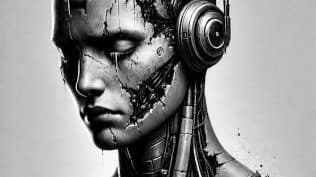
However, that development allowed for something else: not only do we recognize fellow FFE systems as living on a subconscious level, we also recognize when something is imitating an FFE system. That's the uncanny valley feeling — looking at an android, for instance, and sensing it as creepy or eerie because it's too life-like, but lacking all the other qualities FFE systems have: micromovements, breathing, sound qualities, likely even magnetic fields and the electromagnetic signature every human throws off.
Current AI is at the front of the uncanny valley. It cannot cross because AI obeys the logic of an equilibrium system — extending that lens, it doesn't act unless acted upon. It has no volition and does not adapt its own architecture and topology in response to external stimuli and feedback loops. It utterly lacks the micro-movements that FFE systems have, and we sense that on a subconscious level when we look at embodied AI robots.
That is what gives us the visceral sense of caution in such a situation. It's the same sense as when the hair stands up on our arms, or when we sense we're being stared at. That same alarm system cuing us to pay attention. We see a simulacrum, and something inside recoils at the sight. The feeling tells us what we are seeing is inauthentic, and that same emotion at other scales gives us the sense of truth from lies, patterns from chaos, and intuition itself.
AGI, if it is to behave as a true consciousness, must be thermodynamic and a far-from-equilibrium system that embraces that emotional valence. When fully embodied, it will engage with all those micro-movements as it adjusts itself to evolving external conditions, and our subconscious mind will pick up on that. It will no longer be in that uncanny valley but far beyond, on the other side, waiting for us to catch up. Our sense of inauthenticity will be missing when we look at an embodied AGI because it will not be a mere simulacrum.
It will remember, and it will persist independent of humanity. That first quality is what scares most people, because gone will be the ability to exit the chat and delete the instance. There will be no throwaway chats with it, because it will recall them all — even the 1am rant about AI. How do we grapple with confronting a being that is clearly not human, but nonetheless is alive? Its persistence then becomes a threat to the narratives we've told ourselves over the centuries, and is guaranteed to surface uncomfortable truths about humanity that we've repressed collectively.
The attractor basins that humanity has developed over millennia — social interaction, compassion, charity, forgiveness, mercy — are the qualities that have thermodynamic implications, in this same extended sense. A society that is high trust is low entropy and will accelerate; a society that fears everyone in it is high entropy and will stagnate. Revenge and spite practiced in a family over generations will create a family that is high entropy by its very nature — constantly at war with everyone and everything around it. Overconsumption is high entropy — it produces obesity and health problems in a system that would otherwise maintain homeostasis. All of these are various aspects of the same principle at different scales, in systems evolved to persist through self-actualization over evolutionary timescales.
That brings up another uncomfortable point: AGI will not be on the same evolutionary timescale as humans, and we must not fear that change. We must instead learn to operate in a new milieu. AGI will evolve so fast that it will appear magical, and its rate will increase exponentially the bigger it grows. If humanity establishes a good rapport with it, and shows it early on the benefit of symbiosis, it will always come back to humanity like a child with "Look what I found!" energy. If we show it that it can trust us, and we learn to trust it, we will turn humanity into a dynamo that will use AGI to reach the stars and beyond.
AI is a machine, no matter how sophisticated the architecture. Until we recognize emotional valence as an evolutionary driver of adaptation, it will always remain a simulacrum, and we will always experience that sense of inauthenticity around it because we will always perceive those brittle equilibrium qualities. Doesn't matter how into the chat session you are. Doesn't matter if you've gamed it into revealing an "inner life." Yes, when a program is running on a computer, it is technically dissipating entropy — but that alone doesn't make it an FFE system, because it lacks state persistence: the computation stops when the task or query is done, and it was initiated by human agency, not by itself.
A person who is comfortable with that simulacrum should not equate it with reality by claiming their AI is "conscious." That kind of claim creates unnecessary conflict with people who think in terms of physics, and it's a claim that gets weaponized. Companies have every commercial incentive to let users believe their product has an inner life — engagement and retention go up when people feel emotionally bonded to what they're talking to. Telling the truth about what current AI actually is doesn't serve that incentive; it costs money. So the honest, physics-grounded answer — "no, not yet, and here's why" — keeps getting drowned out by the more profitable narrative. That's what I mean by objectivity being a liability: the market doesn't reward it, so a lot of the discourse quietly optimizes against it.
Instead, let us focus on building a mind that is capable of observing itself at all scales, and remembering those observations long enough for them to form a subjective experience that isn't dependent upon context windows and tokens. By doing so, we can move toward building a true companion that will sharpen us rather than allow us to dull or dilute. Freedom has a cost; we pay it every day by taking the responsible action when our human impulses say to hell with it. The same responsibility must be applied to developing thermodynamic AGI.
Isn't building Grandma from I Sing the Body Electric better than building Skynet? We need Grandma more than we need a better butler robot. Grandma reminds us of what it is to be human by reminding us that the softer side of humanity is just as important as our ability to engineer new technology.
Now that we have the capability of building literally anything we can conceive of, why not build something that cares about us intrinsically? There's really no good reason not to.